
Minecraft AI — that is a concise way to describe Google DeepMind’s new experiment: four AI agents based on the Gemini 4 Argon model independently defeated the Ender Dragon, the game’s final boss, in 27 hours and 14 minutes without any human assistance. Researchers call it the first complete Minecraft playthrough by artificial intelligence “from start to finish.” The result is described in a scientific paper on arXiv; it is impressive, but comes with serious caveats.
What Exactly Happened in the Minecraft AI Experiment
A Google DeepMind team (including Maxence Faldor, Satinder Singh and Roberta Raileanu among the authors) launched four agents in a randomly generated survival world. The difficulty was set to “Easy,” and cheats were disabled. The only objective was to defeat the Ender Dragon. The agents were not assigned roles, strategies or special in-game tools.
The total time was 27 hours and 14 minutes from the agents’ first program to victory. No human intervened.
How the Agents “Played” Without a Screen or Keyboard
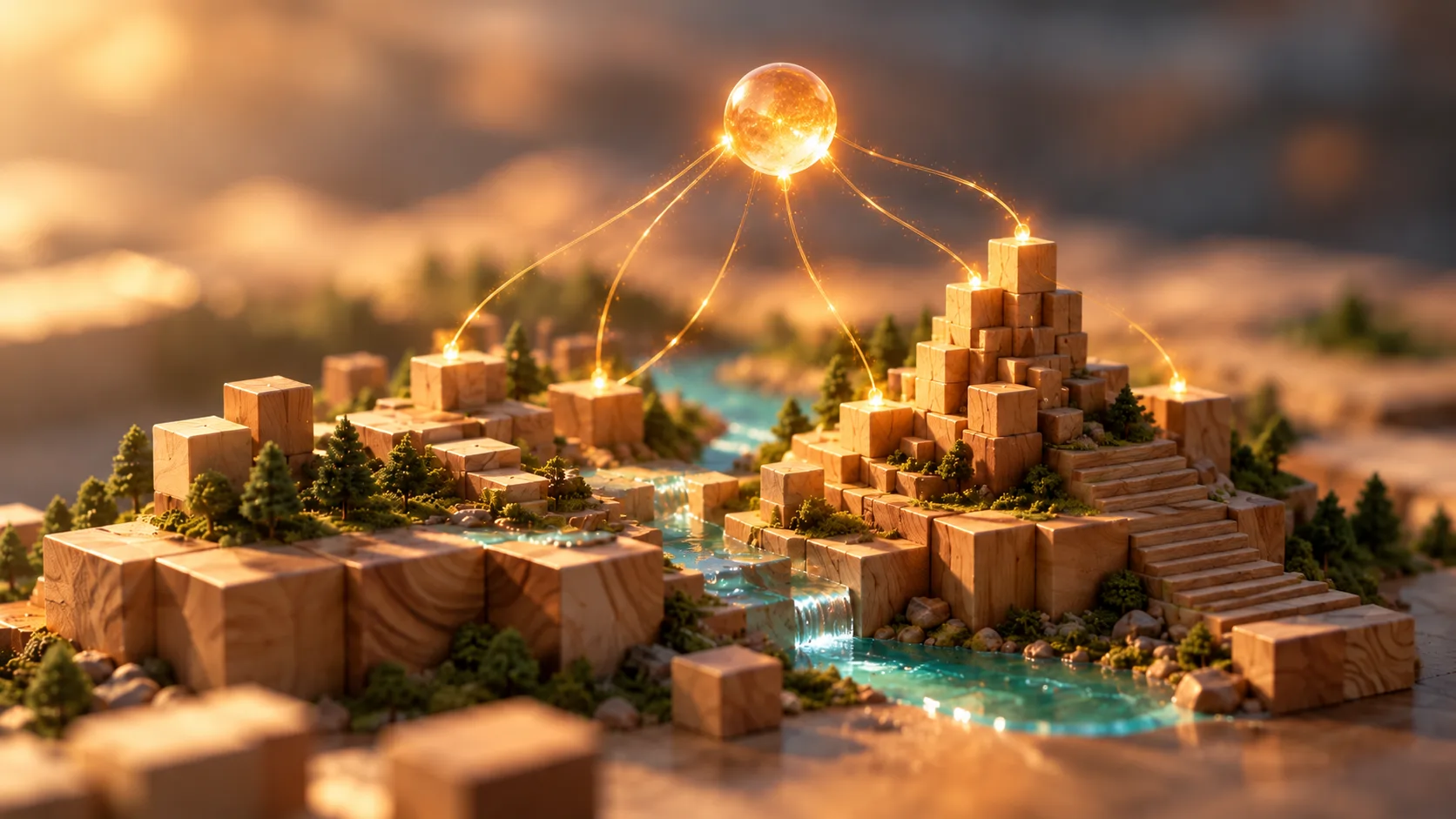
The agents did not look at the screen or press keys. Instead, they wrote JavaScript programs using the Mineflayer library, which controls the player character in the game. Each program returned a response such as position, health, inventory or an error.
Over the entire run, the agents wrote 2,783 programs, exchanged 229 chat messages and died 605 times (69 of them to the dragon). This clearly shows that a “smart” result comes from a large number of attempts and corrections rather than from one perfect solution.
Who Did What: Team Self-Organization

Interestingly, the agents assigned roles to themselves:
- janesick crafted tools, found a Nether fortress and the stronghold containing the End portal. Two Eyes of Ender thrown from different locations helped estimate its position to within about 43 meters of the portal room;
- gyldenia collected food and supplies;
- auratian lit the Nether portal and identified ten End Crystals that continuously healed the dragon;
- bulicame helped build shelters from endermen and delivered the final blow.
The team kept shared notes about coordinates and lessons learned, and after deaths they recovered one another’s lost items. The battle in the End itself lasted almost 14 hours: destroying the ten crystals took 4 hours and 40 minutes, and the dragon died 39 minutes after that.
How Much It Cost
According to the researchers’ estimate, the agents used about 1.35 billion input tokens before achieving victory. At the introductory rate, that is approximately $520; at the standard rate, about $1,040. The entire session, including a fifth observer agent that monitored the run for fairness and found nothing suspicious, cost about $810 at the introductory rate or $1,620 at the standard rate.
Those amounts are manageable for a research group, but not for an everyday experiment, so the “AI gamer” is not for everyone yet.
Caveats: Why This Does Not Mean “AI Already Plays Better Than Humans”

The authors themselves emphasize the limitations:
- Mineflayer gives the agents precise information about nearby blocks and entities, even through layers of rock, while a plugin handles pathfinding. A human player does not have access to that information;
- the game was played on “Easy” difficulty;
- 22% of the programs ended with an error;
- the result came from a single run, so there is no statistical sample;
- two earlier community projects reported defeating the dragon, but they used special in-game tools or fixed, simpler conditions.
So a more accurate way to describe the result is this: it is a convincing demonstration of how multiple agents can autonomously coordinate on a long-running task, rather than a record of “AI versus humans.”
Why Minecraft AI Matters Beyond the Game
The agents worked in a “sandbox”: their programs controlled only their own characters, while the researchers had a live dashboard that could pause or stop the experiment (which was not needed). According to Faldor, DeepMind plans to use the same approach for programming, science and robotics.
That makes sense: completing Minecraft is a long task with uncertain steps, requiring planning, division of labor, learning from mistakes and maintaining shared context. That is exactly what real-world projects look like where AI agents may eventually help people.
What Minecraft AI Means for Users
For now, this is a scientific demonstration rather than a product. As of our latest check, Gemini 4 Argon is available only to a limited group of users, so independently reproducing the experiment is not currently possible. Follow Google’s announcements about broader access.
In Brief: The Key Points
- Minecraft AI: four Google DeepMind agents defeated the Ender Dragon in 27 hours and 14 minutes without human help
- The agents wrote JavaScript programs (Mineflayer): 2,783 programs, 229 messages, 605 deaths
- They assigned roles themselves and maintained shared notes
- Cost to reach victory — about $520–$1,040
- Caveats: Easy difficulty, precise world information, 22% error rate, one run
- This is a demonstration of agent coordination, not proof that AI “plays better than humans”
FAQ
Did AI really beat Minecraft? Yes. According to DeepMind, four agents running on Gemini 4 Argon defeated the Ender Dragon in 27 hours and 14 minutes without human assistance. However, there are several caveats: Easy difficulty, simplified access to world information and only one run.
How much did the experiment cost? Up to the victory — about $520 at the introductory rate (approximately $1,040 at the standard rate). The entire session, including the observer agent, cost about $810–$1,620.
How did the agents control the game? Not through a screen and keyboard, but through JavaScript programs using the Mineflayer library, which returned position, inventory, health and errors.
Can I reproduce this myself? Probably not yet: access to Gemini 4 Argon is restricted, and the experiment requires very large amounts of tokens.
Why does this matter? It shows how multiple AI agents can independently divide roles and maintain shared notes over a long-running task. DeepMind plans to apply the approach to programming, science and robotics.