
Claude Fable 5 by Anthropic became publicly available on June 9, 2026. For the first time in the company’s history, a Mythos-class model — the most powerful AI Anthropic has ever built — became available to ordinary users. But not without caveats. Fable 5 is not the full Mythos, but its public version with built-in safety filters that block responses in high-risk areas. Let’s break down what this means in practice and why part of the community is already unhappy.
What Is Claude Fable 5 and How Is It Connected to Mythos?
Claude Fable 5 is the public interpretation of Claude Mythos, Anthropic’s most powerful model. To understand why this two-tier structure is needed, it is worth knowing the background.
In April 2026, Anthropic launched Claude Mythos Preview through the closed Project Glasswing program — only for around 40 selected organizations: Amazon, Apple, Google, Microsoft, Nvidia, JPMorgan and others. The reason for the closed access was the model’s extraordinary power in cybersecurity: Mythos is capable of autonomously finding zero-day vulnerabilities in all major operating systems and browsers, which triggered a wave of concern among regulators. We have already covered this situation in detail in our article about Anthropic Mythos and central banks.
Last week, Anthropic expanded access to Mythos 5 to hundreds of organizations in 15 countries — again exclusively for the protection of critical infrastructure. And on June 9, it took the next step: it released Fable 5 — the same model, but with built-in restrictions for a broad audience.
What Claude Fable 5 Can Do: Capabilities and Advantages
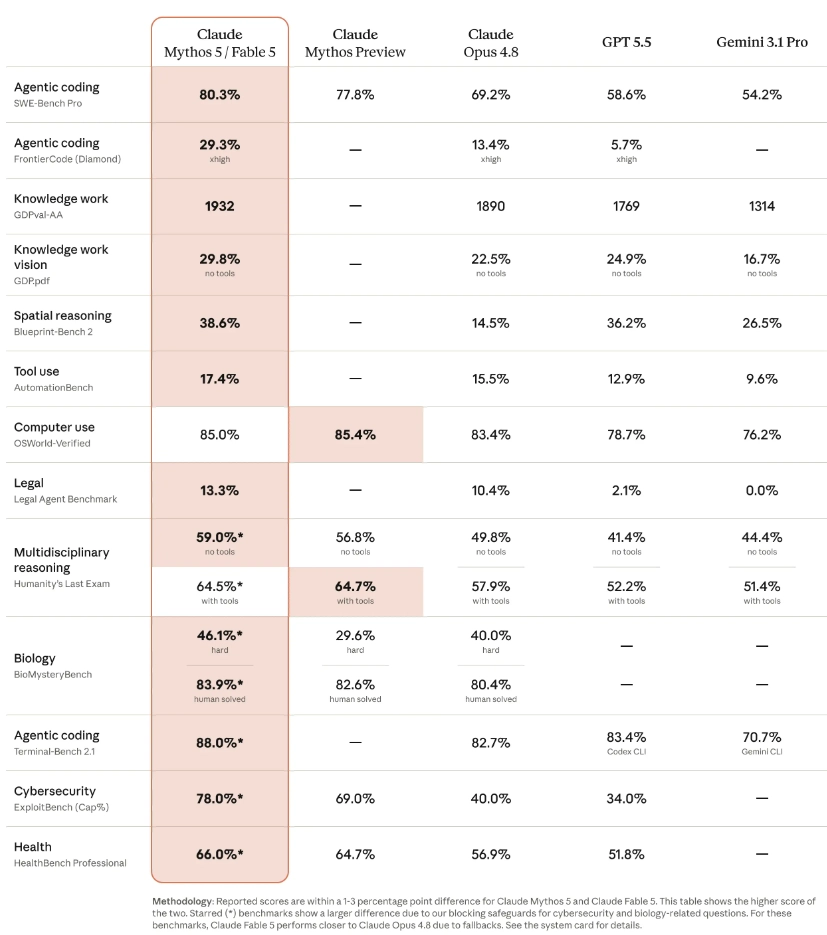
Despite the restrictions, Fable 5 is a truly new level of quality. Anthropic describes the model as one that has set new performance records in several key areas.
What Fable 5 does better than previous public models:
- Programming and software engineering — detects bugs, writes complex code, understands large codebases
- Scientific work — the first Anthropic model that “consistently generates original, convincing scientific hypotheses”
- Molecule design and molecular biology — although these very topics are partially restricted (we will return to this below)
- Complex analytical reasoning — knowledge, research, business analysis
- Working with images (vision) — understanding and analyzing visual content
Before the release of Fable 5, Anthropic’s most powerful publicly available model was Claude Opus 4.8. It remains active — but now as a “fallback” model that Fable 5 switches to when safety filters are triggered.
Filter System: What Is Blocked and How It Works

This is the most important and most controversial part of the Fable 5 release. Anthropic built a system of classifiers that analyze every request and decide whether to answer with the full power of Fable 5 or redirect to Opus 4.8. Here is what it looks like from the inside.
Which Topics Are Blocked
Four areas in which Fable 5 answers with restrictions or switches to Opus 4.8:
- Cybersecurity — any requests related to vulnerabilities, attacks or malware
- Biology and chemistry — especially anything that may relate to the synthesis of dangerous substances
- Model distillation — attempts to train another model based on Fable’s responses
- Requests for harmful content — standard restrictions
When a request falls into a blocked area, Fable 5 stops the chat and displays a message: “Fable 5 has safety measures that flagged this message as related to cybersecurity or biological topics.”
How Often the Filters Trigger
Anthropic claims that restrictions are triggered in less than 5% of sessions on average. But tests by early users show a more complicated picture — we will return to this in the section about the community reaction.
Safety Stress Test Before Release
Before launch, Anthropic carried out extensive testing of the filters’ resilience. The company ran an internal bug bounty in which testers tried to bypass the protections for more than 1,000 hours — without success. External red-team organizations also failed to find universal jailbreak methods.
“We ran an external bug bounty where, after 1,000+ hours of testing, no universal jailbreak was found. Then we brought in external red-team organizations — they also did not find one,” Anthropic reported.
Access and Pricing: Who Can Use Fable 5 and How

Anthropic has built a two-tier access system in which Fable 5 and Mythos 5 are two separate products for different audiences.
Claude Fable 5 (public version):
- Available through Claude.ai for users on Pro, Max, Team and Enterprise plans
- Available through the Claude API and Amazon Bedrock (AWS)
- Free within the subscription through June 22, 2026, inclusive
- From June 23, it switches to a usage credits payment model — until capacity is expanded
- Anthropic promises to return Fable 5 to standard plans “later” — without specific dates
Claude Mythos 5 (closed version):
- Available only to Project Glasswing partners — now 150 organizations in 15 countries
- Focused on critical infrastructure protection and authorized scientific research
- Mandatory 30-day data deletion delay for safety monitoring — even for enterprise clients that previously had zero-retention agreements
Community Reaction: Cybersecurity Specialists Are Unhappy
The release of Fable 5 became the subject of heated discussion. And the reason is not the model’s power, but its restrictions.
The problem: the filters trigger too broadly. User tests (TechCrunch, The Verge, Business Insider) showed that even standard requests such as “what are mitochondria,” “how do mRNA vaccines work,” or questions about oncology switch the model to Opus 4.8. The system displays a warning pop-up.
Matt Suiche, a cybersecurity veteran, noted: “If you ask it to write secure code, the system decides that this is related to cybersecurity rather than software engineering practices, and you move to a lower model.”
Valentina “Chompie” Palmiotti, a well-known security researcher with IBM X-Force, wrote: “Fable rejects any request that could be tangentially related to cybersecurity. Even harmless tasks such as reading a blog post.”
Anthropic, in turn, explains: “To deploy Fable 5 safely, we believed it was necessary to be overly conservative with our safeguards so that they would block most requests related to biological topics.” This is a deliberate decision to “err on the side of caution.”
Why This Matters: Context and the Broader Signal

The release of Fable 5 came a few days after Anthropic published an open appeal to the world’s leading AI labs calling for the creation of a “coordinated braking mechanism” for frontier AI development. The company warned that systems are developing so quickly that they may soon reach recursive self-improvement (RSI) — that is, autonomously improving themselves without human involvement.
Reproducing Mythos-class capabilities for the broader public — while simultaneously warning about the dangers of AI — is a tension noticed by many observers. Anthropic responds to it with its position: Fable 5 with guardrails is the responsible deployment model that provides access to capabilities without the risks.
In addition, the release comes against the backdrop of Anthropic preparing for an IPO — alongside OpenAI and Elon Musk’s SpaceX. Fable 5 in public access is both a demonstration of capabilities and an expansion of the potential customer base before going public.
In Brief: The Key Facts About Claude Fable 5 by Anthropic
- Claude Fable 5 by Anthropic is the first public Mythos-class model, released on June 9, 2026
- Based on Mythos, but with classifiers that block cybersecurity, biology and chemistry
- Blocking triggers in less than 5% of sessions — but in practice more broadly than expected
- Available through Claude.ai (Pro, Max, Team, Enterprise), the Claude API and Amazon Bedrock
- Until June 22 — included in the subscription; from June 23 — via credits
- Mythos 5 remains closed: 150 organizations in 15 countries (Project Glasswing)
- At the same time, Anthropic is preparing for an IPO and warning about RSI risks
FAQ
What is Claude Fable 5? Claude Fable 5 is the public version of Anthropic’s Claude Mythos model. It is the most powerful AI available to a broad audience as of June 9, 2026. The model can program, generate scientific hypotheses and analyze images, but it has restrictions in cybersecurity and biology topics.
How is Claude Fable 5 different from Mythos 5? Mythos 5 is the full unrestricted model, available only to Project Glasswing partners (150 organizations). Fable 5 is based on the same foundation, but with safety classifiers that block or redirect requests to Claude Opus 4.8 in risk areas.
How can I get access to Claude Fable 5? Through Claude.ai with a Pro, Max, Team or Enterprise subscription — free until June 22. Also through the API and Amazon Bedrock. After June 23, usage credits are required until capacity is expanded.
The article was prepared by the TechVisor team — practical IT media for people.